- Decision
- Which queue a support ticket joins
- Cost of a miss
- An urgent case waits
- Success
- Right queue on held-out tickets
- Try first
- Keyword rules, then a model
01 / 06
AI and machine learning
- Four stages
- 01 Define
- 02 Baseline
- 03 Evaluate
- 04 Guard
Models and AI features built for a defined task, evaluated against the conditions they will face, and deployed only where they genuinely add value.
FILM1:02
AI and machine learning at Aksali, in one minute
From the problem and the data to models, the engineering around them, and AI that fits real products.
Read the transcript
Every business is being told it needs AI. The better question is simpler: what problem should it solve?
It starts with the data: what it can support, and what it cannot.
Sometimes a rule or a query is enough. When a problem genuinely needs machine learning, we design it for that task.
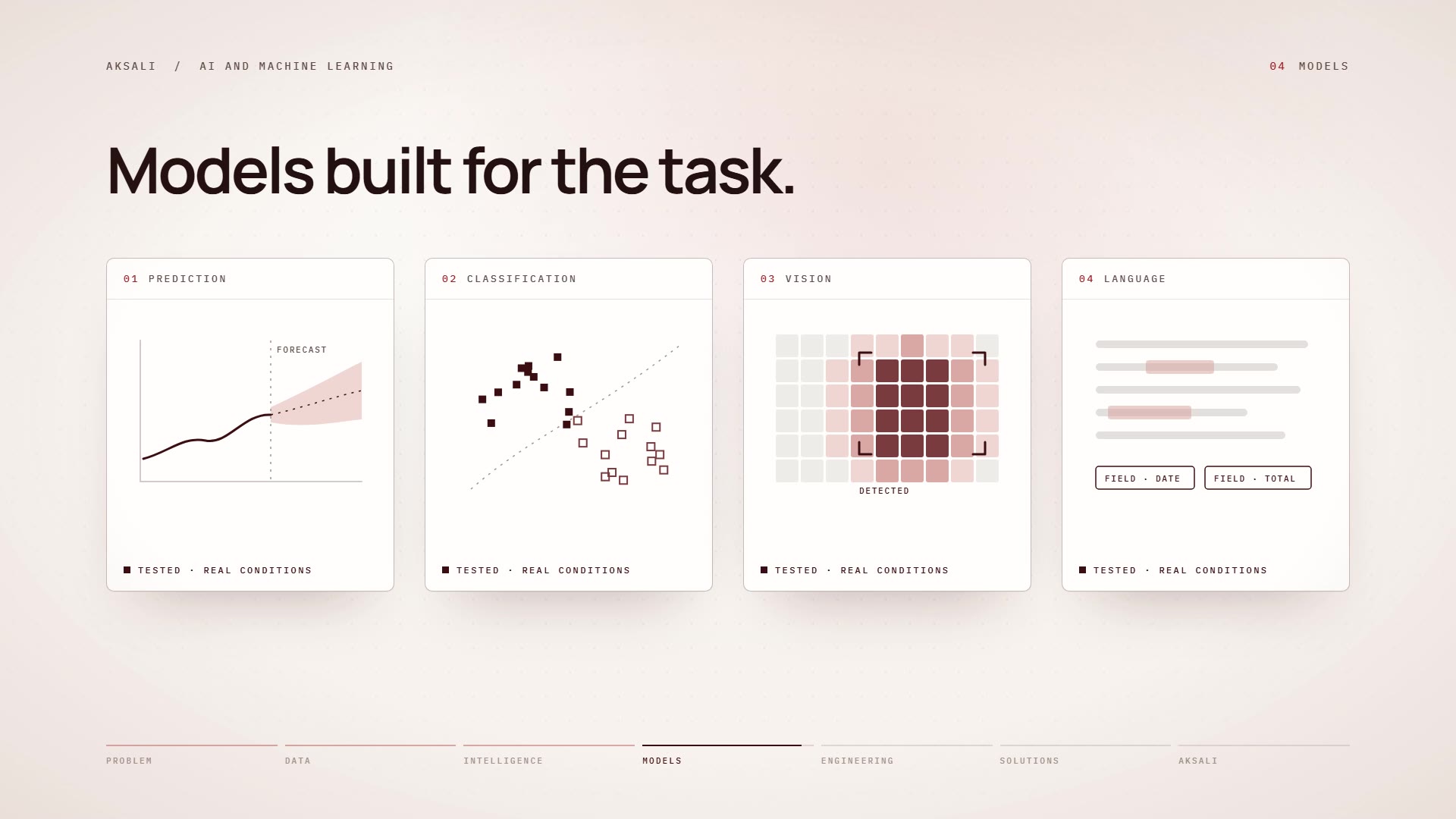
Models for prediction, classification, vision and language, tested against the conditions they will actually face.
Then we engineer everything around them: validation, monitoring, and outputs checked in code before anyone relies on them.
The result is AI that fits real products and real operations: forecasting, document understanding, search, and decisions you can explain.
AI that can be measured, explained and trusted. Aksali Technologies. Genuine engineering.
WHAT IT IS
AI that can be measured, explained and trusted.
Machine learning is the right tool when a problem depends on patterns too varied to write down as rules: reading images, ranking text, predicting from history. It is the wrong tool more often than the industry admits.
Our work covers both sides of that line. We decide whether a model is needed at all, and when it is, we build one that holds up outside the notebook: evaluated on realistic data, checked in code, and served behind an API your team can run.
PROBLEMS WE SOLVE
Where AI projects usually go wrong
Most failures are not about the model. They are about the task, the evaluation or what happens after the demo.
- 01
A model that scored well and fails in use
Test accuracy hid a data leak, a skewed split or a metric that rewards the wrong thing. We rebuild the evaluation so the score means something.
- 02
Fluent answers nobody can check
Language models write confident text whose figures may be wrong. We separate what is computed from what is phrased, and verify one against the other in code.
- 03
An AI idea without a defined task
A goal like “add AI” becomes a specific task with a success measure, or an honest recommendation to solve it without a model.
- 04
A prototype that never reaches production
Notebook results nobody can run, monitor or update. We put models behind reliable APIs, with the tests and documentation to keep them working.
HOW WE WORK
From a defined task to an output you can trust
Four stages, each with a clear exit test. A project can stop at any of them with a useful answer.
01Define
Frame the task
We agree what the system must decide, what a wrong answer costs, and how success will be measured. Then we check whether a rule, a query or a model fits best.
02Baseline
Beat something real
We build the simplest credible baseline first. Every model after it has to outperform something real, not an imagined zero.
03Evaluate
Measure what matters
We train on data that reflects real use, check calibration, look for leakage and read the errors one by one. Results are reported with their limits.
04Guard
Check before anyone sees it
Outputs pass through validation written in code before they reach a user. The model is served behind an API, with logging and a path to retrain.
WHAT WE PROVIDE
What we provide
Predictive models
Classification, prediction and analysis on structured data, from feature work to calibrated outputs.
Computer vision
Image classification and medical imaging models, built so that their decisions can be inspected.
LLM features
Retrieval-augmented search, document question answering, summarisation and structured extraction, grounded in your data.
Evaluation and audit
Calibration, error analysis, leakage checks and honest reporting, for models we build or models you already have.
Interpretability
Clear explanations of why a model decides what it decides, for your team, your users or a reviewer.
Model deployment
Models served behind reliable APIs, with input validation, logging and a route to retraining.
TYPICAL APPLICATIONS
Typical engagements
- 01
Add an AI feature to a product
Grounded question answering, summarisation or extraction, built into software you already run and guarded against invented content.
- 02
Check a model before you trust it
An independent evaluation of an existing model: what it gets right, where it fails, and whether the reported numbers hold.
- 03
Turn data into a decision
A model for one defined decision, from the first baseline to a deployed and monitored service.
- 04
Decide whether AI is the answer
A short feasibility study that ends in a clear recommendation, including when the recommendation is not to use AI.
WHY IT IS DIFFERENT
AI engineered, not demonstrated
The difference is rarely the model. It is everything around it.
| Common practice | How we work |
|---|---|
| Start with a model and look for a use | Start with the task, and use a model only when it earns its place |
| Report the best score on a convenient test set | Evaluate on data that reflects real use, and report the limits |
| Trust the output by default | Check outputs in code before anyone sees them |
| Hand over a notebook | Hand over a tested service, documentation and a way to retrain |
WHAT TO EXPECT
What you can expect
A direct line to the engineer
You speak with the person designing and building your system, from the first call to hand-over.
A written plan before we build
What we will build, how, what it will take, and how we will know it works.
Working software early
Short increments you can see and test, rather than one reveal at the end.
Honest reporting
Results reported with their limits, and a clear word when a simpler approach would serve you better.
Everything handed over
Code, documentation and what you need to run and extend the system yourselves.
Have a problem that might need AI?
Tell us what you are trying to decide or automate. We will tell you honestly whether a model is the right answer.
Start a conversation