02 / 06
Software engineering
Web applications, dashboards and internal tools with clean architecture, sensible tests and code your team can keep building on.
WHAT IT IS
Software that stays easy to change.
Most of the value of software arrives after launch, when it has to change: a new rule, a new kind of user, a new integration. We design for that moment.
That means clear boundaries between the parts of a system, types that catch mistakes before they run, and tests that describe what the software must always do. The result is a codebase that gets easier to work on, not harder.
PROBLEMS WE SOLVE
What we are usually asked to fix
Rarely a missing feature. Usually a process, a codebase or a first version that cannot carry what is being asked of it.
- 01
Work running on spreadsheets and email
A process that outgrew its spreadsheet. We replace it with an application that enforces the rules the spreadsheet could only hope for.
- 02
A codebase everyone is afraid to touch
No tests, unclear structure, slow pages. We improve it in place, one measured step at a time, without a risky rewrite.
- 03
An idea that needs to exist
A first version built quickly, on foundations you will not have to throw away when it succeeds.
- 04
Software that works until it does not
Edge cases, bad inputs and race conditions found by users. We make them part of the test suite instead.
FILM0:55
Software engineering at Aksali, in one minute
From the work itself to the architecture, small working increments, tested changes and software that lasts.
Read the transcript
Software is easy to start, and hard to keep. The real test: will it still be easy to change next year?
We begin with the work itself: the people, the rules and the exceptions.
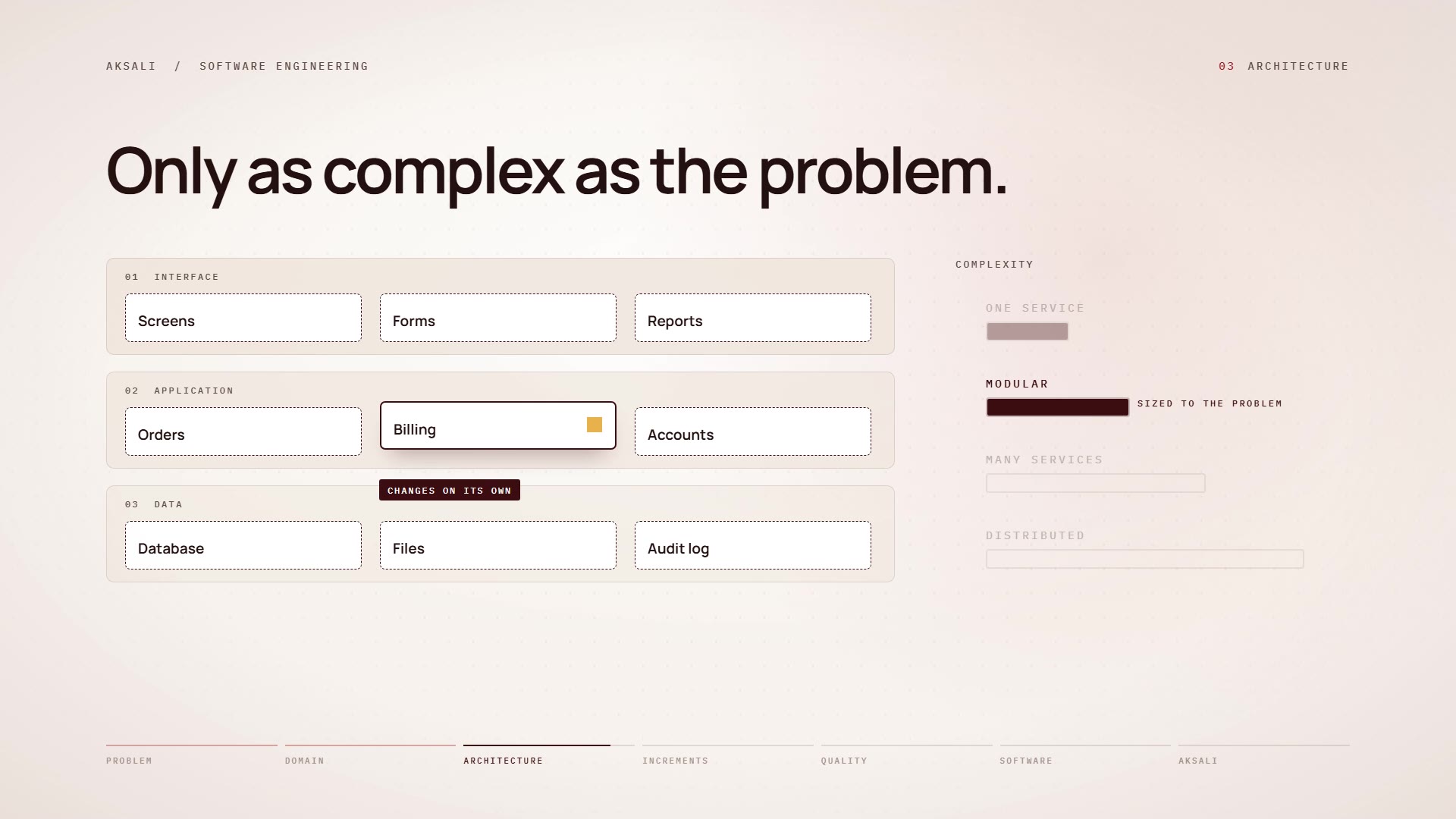
Then we shape an architecture only as complex as the problem. Clear boundaries, so each part can change on its own.
We build in small increments, so you use real software early.
Every change is reviewed and tested, with the rules written down as code.
The result is software that fits the way you work: web applications, dashboards, internal tools and first versions.
Software that is simple, tested and durable. Aksali Technologies. Genuine engineering.
HOW WE WORK
From a domain to a codebase you can own
We design the structure before the screens, and we show working software early and often.
Model the domain
We name the things the software deals with and the rules between them, before any screen is drawn.
Shape the architecture
Interface, logic and data are kept separate, so each can change without breaking the others.
Build in increments
Working software arrives in short increments, each one typed, tested and reviewable.
Harden and hand over
End-to-end tests cover the journeys that matter. You receive documentation and a codebase your team can own.
WHAT WE PROVIDE
What we provide
- 01
Web applications
Complete applications with authentication, roles and the workflows your users actually follow.
- 02
Dashboards and internal tools
Interfaces for operations teams that replace manual processes and shared spreadsheets.
- 03
Prototypes and first versions
First versions that prove an idea, built so that the second version can grow from them.
- 04
Codebase improvement
Structure, performance and test coverage improved in place, with every change measured.
- 05
Testing strategy
Unit, integration and end-to-end tests aimed at the failures that would actually hurt.
- 06
Documents and exports
Generated PDFs, spreadsheets and documents that match the screen and are checked before download.
TYPICAL APPLICATIONS
Typical engagements
- 01
Replace a manual process
An internal tool that takes a process out of spreadsheets and email, and enforces its rules.
- 02
Build a first version
A product taken from idea to working software, with the architecture to keep growing.
- 03
Rescue an existing application
An inherited codebase made safe to change: tests first, then structure, then speed.
WHY IT IS DIFFERENT
Built for the second year, not the demo
A codebase is judged by how it behaves when it has to change.
| Common practice | How we work |
|---|---|
| Optimise for the first demo | Optimise for the second year of the codebase |
| Add tests at the end, if time allows | Write tests that describe the rules, alongside the code |
| Rewrite when it gets hard | Improve in place, one measured step at a time |
| Keep knowledge in one developer’s head | Treat documentation and hand-over as part of the work |
WHAT TO EXPECT
What you can expect
A direct line to the engineer
You speak with the person designing and building your system, from the first call to hand-over.
A written plan before we build
What we will build, how, what it will take, and how we will know it works.
Working software early
Short increments you can see and test, rather than one reveal at the end.
Honest reporting
Results reported with their limits, and a clear word when a simpler approach would serve you better.
Everything handed over
Code, documentation and what you need to run and extend the system yourselves.
Have software that needs to exist, or to change?
Describe what it should do and where it is stuck. We will suggest the simplest route to software you can keep.
Start a conversation